|
|
|
||
|
|
|||
|
|
|||
|
|
|||
|
|
|||
|
|
|||
|
... |
|
The Home of DIY and Home Improvements |
|
Welcome to 'Security'- Learn About The World Of Locks And Security |
|
|
|
||
|
|
|||
|
|
|||
|
|
|||
|
|
|||
|
|
|||
|
... |
|
. |
Mortice Locks |
|
||
|
. |
There are many types of locks available, but how do you decide which is the best to use? Insurance companies and the police recommend a five lever mortice deadlock which has the British Standard 3621:1980 kite mark stamped on it. In fact, many insurance companies now insist that if you want them to insure you, you must have (in addition to other requirements) the British Standard rating on your locks. But what does all this mean, and why is it an important security device compared to other locks. A British Standard deadlock must have the following:
The
mortice lock is very popular, and has been in existence for many
years. Chances are, you already have them fitted to your
existing doors. A mortice lock is the type that has been
designed to fit inside a door by means of a 'mortice'
(A mortice is simply a woodworking term that describes a hole that
has been cut into timber as part of a woodworking joint, hence the
term 'mortice lock'), rather than the type designed to fit onto the
door surface, such as the rim lock, rim cylinder lock, or night latch. Security Locks Combinations Combinations in locks gives greater flexibility and security. Example combinations could be:
|
|
||
|
. |
|

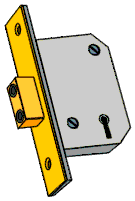 The
mortice deadlock shown here on the left, fits into the door, does
not have handles, and operates by key only. When the door is closed,
only the key hole or the plate that covers it (the escutcheon plate)
can be seen. The locking action is achieved by a bolt that shoots out
of the lock when the key is turned, which goes into a metal striker
plate that is fitted into the doorframe. The locking bolt cannot
be pushed or pulled back, (is not spring loaded) without using the
key, so by unlocking it. This feature where the
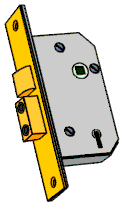 locking bolt is fixed, is known as 'deadlocking', hence the term;
deadlock. This type of lock would be used as a secondary device in
addition to a lock with a latch action.
 Alternatively,
a sashlock with handles fitted at the center of the door, with two
mortice deadlocks, one at the top and bottom, all 'keyed alike' for convenience.