|
|
|
|
||
|
|
||||
|
|
||||
|
|
||||
|
|
||||
The DIY World
|
The Home of DIY and Home Improvements |
|
Welcome to 'Security'- learn about the world of locks and Security |
Burglary is an unfortunate part of life these days, don't just be a victim of crime, fight back! I'll show you how it can be done.
|
|
||
|
Security Locks The deadlocking action of the mortice lock, coupled with being concealed, gives this lock an added feature, which is; that it's as difficult to open from the inside (when the key is absent) as it would be from the outside. This feature, is another important aspect of home security, though not immediately apparent. Consider as an example the situation; a burglar has entered the house by means of a small downstairs window, which has been left open. The house has mortice deadlocks fitted to both front and back doors, both are locked and the keys have been removed. Though inside the property, with goods available to steal, the burglar does in fact have a problem, which is; how to get the goods out, given that the normal and easiest exit routes are locked. If the windows are the small 'top opener' types, or securely locked by keys, getting a wide screen television out through them could also prove to be very difficult. A professional would probably have consider this situation as part of his plan and could very well have been put off by it, where as the opportunist, after taking advantage of the open window, would probably flee with just what he could easily carry, or even empty handed if an alarm was sounding.
Given
that the levers bring about the actual locking
Though
all levers work in a similar way, not all levers are the same. They
can either have a narrow gap or opening to one edge, so that when the
lever is lifted by the key, the bolt stump can travel through the
gap. Alternatively, it can be the closed type, where the stump
moves from one side to the other within the lever when lifted.
When the key is inserted and turned, what it does in addition to pushing the bolt either in or out of the lock, is to lift all the levers up, together. However, because of the differences in the lever patterns, it is required that each lever is raised to a different height, there by aligning all the gaps to each lever, collectively. Because the key pattern is unique and matches that particular lever set, it can do this, so by creating a pathway, allowing the bolt to move through them all. The Locksmith Locksmiths use specials tools known as picks, which, together with a great deal of practice, makes it possible to open such a lock using a tried and tested technique. Given that this delicate operation is not visible to the locksmith, it means working blindly and has much to do with what could be described as; knowing at what stage one is at, in relation to the position the levers, by means of 'feel'.
To
overcome this technique and to fool the burglar, (with Quality As you have read, the mortice deadlock, has a great deal to offer in the way of security, made better by a standard being set. What this means in real terms is, that it takes away the guesswork when making a lock choice, whichever lock you choose that carries the British Standard rating will have to meet the same specification. There are lock manufacturers that have become a household name when it comes to security and I would not dispute their reputation in this respect. That said though, this does not necessarily mean that the cheaper locks are not a good buy, in fact, many are, in my opinion, every bit as good. On the other hand, there are mortice locks out there which are very cheap indeed and when compared, it is obvious that corners have been cut to achieve this, there is a difference in quality, being less substantial, not as robust. Therefore, when it comes to lock choice, the British Standard rating will give you a guaranteed level of specification, but you should also consider build quality, which is also part of the equation. You don't have to be an expert in locks to see this difference and if you are paying a third of the price, there is usually a good reason for it, unless that is, it's on offer. None BS Mortice Locks Does this mean that non British Standard mortice deadlock are not as good when it comes to security? The answer to this question is, not necessarily. In fact there are five lever locks on the market that are far superior in build quality than many of their British Standard counterpart, it's just that the British Standard rated locks have certain requirements that insurance companies may insist upon, that the none British Standard may not have. To be on the safe side, use a good quality, robust, British Standard mortice deadlock. Continued on page: 4 |

 Levers
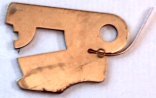 action, makes the levers an important part of the lock. For
general domestic use, mortice locks can have between two and seven
levers, the more there are, the harder it is for the lock to be
picked. A lever is a flat, brass, spring loaded plate, that has
a unique pattern or shaped 'cut-out'. When the bolt is in the
locked position, it cannot be pushed back because it is trapped in
the 'cut-out' of the levers.
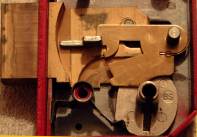
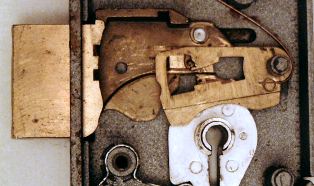 Shown
here is a single lever in two different types of deadlocks.
The bolt cannot travel back because the stump of the bolt is held in
place by the lever. Before it can move, the lever would need to
be raised so that the gap to the edge or within the lever lines-up
with the stump.
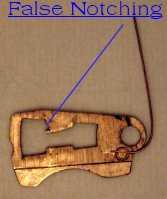 False
Notching
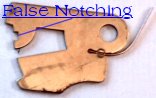 lock
picking skills) the manufactures have incorporated a neat little
feature known as 'false notching', which could be described as a one
way, dead end gap cut into each lever. This false gap or notch,
in addition the true gap, is designed to give a false reading whilst
the lock picking technique is in progress, so that when a false notch
is entered, it can give the impression that the lever has been raised
to the correct position. It's only upon reaching the stage
where the lock should open that it is realised that a false notch has
been entered, a situation to which there is no turning back.
This means that the process has to be started all over again from the beginning.